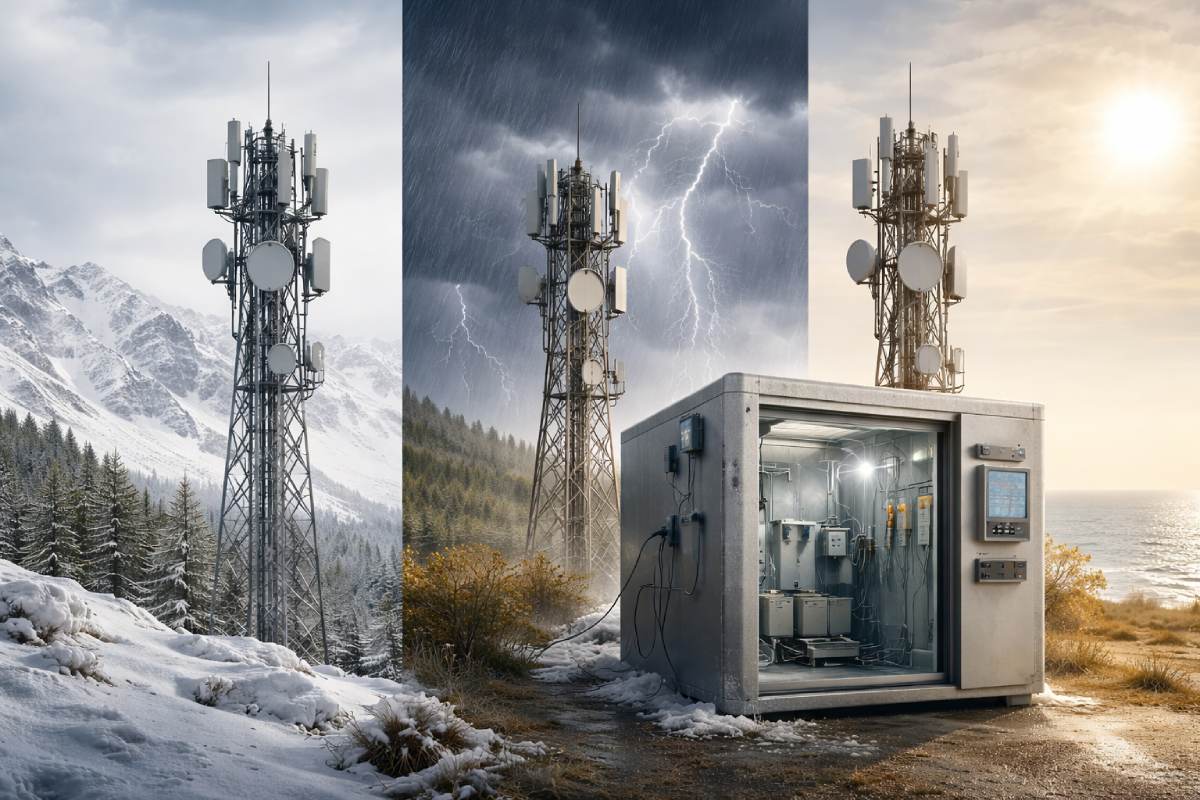
Have you ever given a thought to how climatic stress affects you? Do they affect telecom devices as well? Have you ever experienced that during a high thunderstorm situation, telecom devices start malfunctioning? Or the towers sometimes fail to give the signals properly, so climatic stress testing might be something that telecom device manufacturers need to consider when they are installing towers and systems.
Have you seen how the big towers are installed on the hilltops of the Himalayas, and even on the remotest locations where the weather is harsh, telecom device running towers are installed.
So imagine, where even people can’t live, telecom devices have to run, so of course they need to go through climatic stress testing.
If you are still wondering about the climatic stress testing, its methods, and standards, then read this blog through and through, and learn about everything.
Why Climatic Telecom Device Testing Matters?
Telecom devices are exposed to some of the harshest environments in the world. Telecom manufacturers, as you deploy devices in India’s diverse climates and climatic stress testing qualifies your designs to withstand extreme conditions without failure.
Think blistering heat, biting cold, high humidity, heavy rainfall, salt-laden coastal air, and intense UV radiation. Without environmental validation, devices can:
- Fail unexpectedly
- Lose RF performance
- Experience corrosion and material fatigue
- Suffer from condensation-related damage
- Reduce network uptime
So you can understand why the climatic tests for your telecom devices are essential for seamless and optimal performance.
Key Methods For Testing
Manufacturers, expose your telecom gear to temperature cycling from -40°C to +70°C in chambers to reveal material weaknesses like expansion mismatches.
Run humidity tests such as damp heat cyclic (up to 95% RH) and thermal shock for rapid shifts, alongside vibration, mechanical shock, and salt mist to mimic transport and salty coastal exposure.
Environmental testing allows the devices to be more reliable and trusted in difficult conditions. Use drop, topple, and IP/IK enclosure tests for portable units, ensuring they survive Himalayan drops or desert heat without irreversible damage.
Let’s look at each of the different testing methods that will work for climatic stress understanding.
1. High Temperature Testing
In this test, the hot and warm weather conditions between 45°C to +70°C are ensured, and ensure that in desert terrains where the temperature can go up to those levels do not give thermal stress and operate properly.
2. Low Temperature Testing
This helps in figuring out whether the high altitude and low temperature areas, like high in the Himalayan region, or cold deserts like Ladakh. In the places where the temperature can go as low as –10°C to –40°C, this method of testing is useful.
3. Thermal Shock Testing
Replicates sudden temperature transitions. This mimics real-world situations where weather shifts rapidly within hours.
4. Humidity and Damp Heat Testing
High moisture environments, especially tropical or coastal regions, can ruin circuits and accelerate corrosion. Humidity testing evaluates moisture resistance.
5. Salt Fog / Salt Spray Testing
This method is critical for telecom systems installed near coastal regions. Checks how resistant devices are against corrosion caused by salty air.
6. Solar Radiation (UV Exposure) Testing
These tests show how prolonged sunlight affects materials and whether the devices can withstand that exposure. This is important for towers exposed to direct sunlight for years.
7. Combined Climatic + Mechanical Stress Testing
Evaluates how devices behave when vibration, shock, and environmental stress occur together. Particularly in conditions like during storms or earthquakes, the devices that are tested can perform much better.
Climatic Stress Testing Governing Standards
1. IEC 60068 Series
This standard is the most widely used environmental standard for dry heat, cold, thermal shock, humidity, and salt mist.
2. IEC 60721
Defines environmental condition categories.
3. MIL-STD-810H
A military-grade standard for rugged and extreme conditions testing.
4. ETSI Environmental Standards
Common for European telecom devices, especially RF and networking equipment.
5. TEC (India) Requirements
For MTCTE-regulated devices, TEC relies heavily on IEC and MIL-STD environmental standards.
These standards ensure that telecom equipment withstands real-world environmental pressures before entering the market. This can make your devices ready for the harsh and unpredictable climatic stress and ensure that optimal performance can be achieved.
Impact On The Industry
Climatic stress testing has become a crucial part of the telecom product lifecycle because:
- Devices must operate in diverse Indian climates, which can range from –40°C to +70°C.
- Telecom operators demand stringent testing before deployment.
- Reliability directly influences customer experience and network uptime.
- Better environmental resilience means lower maintenance costs and fewer field failures.
As 5G, IoT, and fiber networks expand, the industry’s dependency on durable, weather-resistant devices has only increased.
FAQs (Frequently Asked Questions)
Here are some frequently asked questions about Climatic Stress Testing for Telecom Devices:
Is climatic stress testing mandatory for all telecom devices?
Many MTCTE categories require it, especially outdoor and network-critical equipment.
How long does climatic testing take?
It varies some tests take hours, while humidity or salt fog tests may take days.
Can devices be tested while operating?
Yes, operational testing during environmental stress provides deeper insights.
Does passing these tests guarantee field performance?`
It significantly boosts reliability, but proper installation and maintenance are still essential.
Summing Up
Climatic stress testing ensures that telecom devices don’t just work in ideal, work everywhere. India is a big country with a very diverse climatic condition, while some parts of the country suffer from high temperature, some areas witness intense rainfall, or some parts witness extreme cold. And the telecom system needs to sustain all these diverse weather conditions.
So, if you are a manufacturer or a seller of telecom devices, then you need to understand that right testing method following the right standards for the climatic stress can actually help you and your device to sustain difficult conditions better, and provide the best telecom service that customers can ask for.