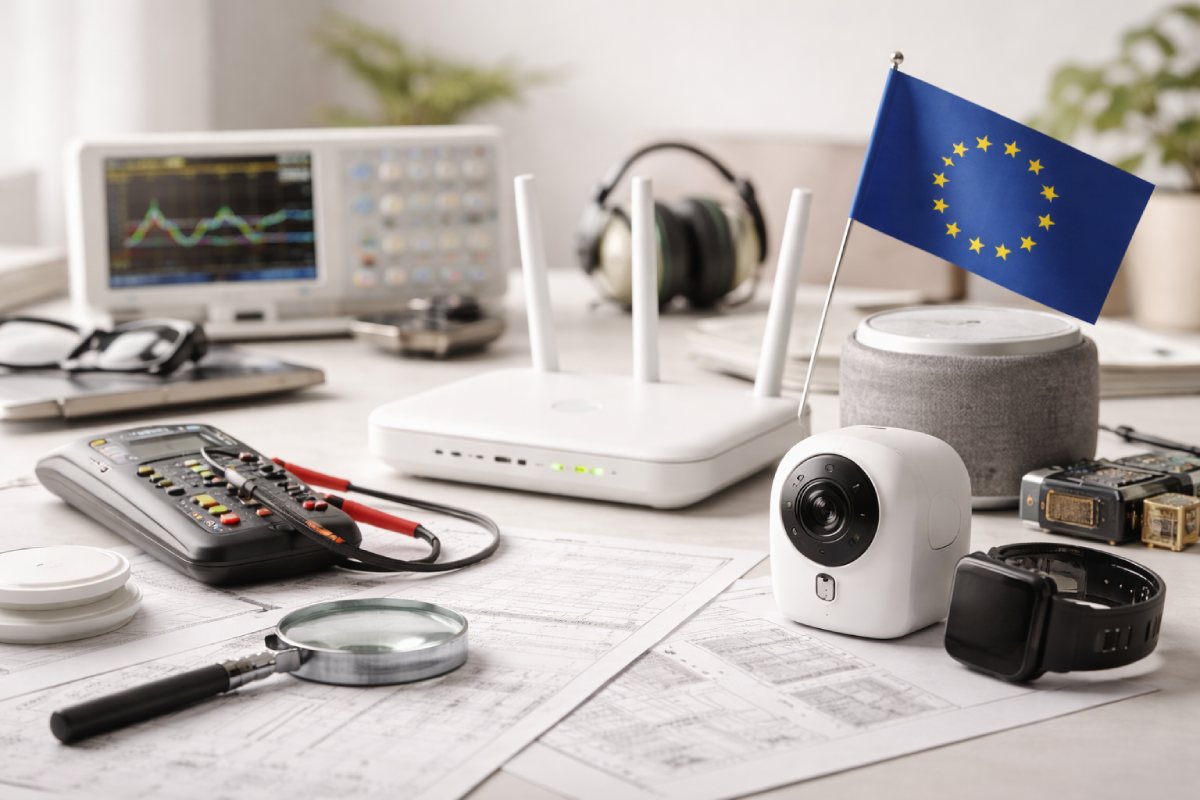
When laboratory tests create CE Marking for IoT Devices, it creates the impression that all main challenges have been solved. The actual evaluation starts when you attempt to bring it to European markets.
CE marking functions as an essential requirement that companies must fulfill to demonstrate their product meets European Union safety and compliance standards.
IoT products experience a complex certification process which requires them to meet various standards including radio regulations, electromagnetic compatibility tests, safety requirements, documentation requirements and third-party evaluation at times.
The blog provides a comprehensive explanation of the process behind CE Marking for IoT Devices through its step-by-step breakdown.
What is CE Marking for IoT Devices and Why Does It Matter?
The router and smartwatch back label serve as a CE compliance for connected devices. The CE mark on the product proves that the manufacturer met European health safety standards and environmental protection requirements.
The mark serves as a mandatory requirement for products that fall under particular EU legislative frameworks because it enables your device to access the European Economic Area (EEA) marketplace.
The CE marking for smart devices functions as a legal requirement for connected device manufacturers while it also provides customers with product safety assurance. The European Commission maintains the official documentation that explains the CE certification system.
CE Certification for IoT Products
An IoT product must comply with multiple regulatory requirements from different directives that apply to its operation.
The Radio Equipment Directive (RED 2014/53/EU)
The CE RED directive IoT applies to any device that transmits or receives radio signals through technologies such as Wi-Fi, Bluetooth, cellular networks or LoRa.
The RED regulations establish requirements for product safety, electromagnetic compatibility, spectrum management, and essential cybersecurity and privacy protection which became mandatory through recent updates.
The Electromagnetic Compatibility (EMC Directive 2014/30/EU)
Establishes emission limits and immunity standards that prevent devices from generating interference with each other. (Harmonised standards from ETSI are common references.)
The Low Voltage Directive (LVD 2014/35/EU)
Applies to your equipment when it functions within LVD voltage ranges which usually include mains-powered devices. LVD does not apply to battery- or USB-powered IoT devices but users should verify the specific voltage requirements.
RoHS / REACH / WEEE
The environmental regulations and waste management rules of RoHS / REACH / WEEE become applicable according to the specific components used and the entire product lifecycle.
Cybersecurity requirements
The Cybersecurity requirements for RED were updated through delegated rules which establish rules for network protection, personal data security and software update security.
The Cyber Resilience Act will establish product-security requirements for digital products that organizations need to monitor throughout their implementation schedule.
CE Marking For IoT Devices Example
The following products require CE Marking for IoT Devices to be sold within the EU and EEA markets:
- Smart home Wi-Fi cameras
- Video doorbells
- Smart speakers (Alexa-enabled devices, voice assistants)
- Smart thermostats
- Smart plugs and smart switches
- Connected POS terminals and payment devices
- Cellular routers and MiFi devices
Harmonised Standards for CE Marking for IoT Devices
The EN/ETSI standards provide a presumption of conformity through their unified European standards. The Internet of Things uses the following standards:
- The EN 301 489-1 standard and its parts for EMC and radio equipment.
- The EN 300 328 standard governs wideband transmission systems that operate in 2.4 GHz Wi-Fi and Bluetooth frequencies.
- The EN 62368-1 standard establishes safety requirements for ICT equipment that manufacturers use for LVD compliance testing.
- The EN 62479 and EN 50371 standards establish limits for human electromagnetic field exposure through specific testing procedures.
The use of harmonised standards enables easier demonstration of as per the CE marking guidelines because it meets all the requirements.
Step-by-Step Testing & Certification Process for CE Certification for IoT Products
Here’s a practical workflow that product companies use for CE certification for IoT products:
Step 1: Scoping & Baseline Risk Assessment
Tell the story of the product’s intended use, environment, interfaces, and user. Identify applicable directives and essential requirements.
Step 2: Standards Mapping
Map harmonised standards that cover those requirements (EMC, radio, safety, environmental, cybersecurity guidance). Use ETSI and Commission lists.
Step 3: Pre-compliance Checks
The team conducts fast in-house tests for emission detection, basic immunity assessment and antenna performance testing to identify early design problems.
Step 4: Laboratory Testing (Full Compliance)
Send units to accredited labs for:
- EMC emission and immunity tests according to EN 301 489 standards.
- Radio performance tests and spectrum occupancy tests according to EN 300 328 and EN 300 220 standards.
- Performing safety examinations according to EN 62368-1 standards whenever the LVD requirement applies.
- Assessing RF exposure through SAR testing whenever it becomes necessary.
- Conducting environmental and chemical examinations through RoHS testing whenever it becomes necessary.
- Cybersecurity assessment which requires compliance with the current RED requirements and the forthcoming CRA standards which include secure default settings and update mechanisms.
Step 5: Technical Documentation Assembly
This process requires assembling the test reports, risk assessments, design drawings, component specifications, user instructions and maintenance and update policies. The organization needs to keep this technical file for the legally required storage period which typically lasts 10 years.
Step 6: EU Declaration of Conformity (DoC)
The DoC document requires your signature and date because it contains information about the relevant directives and standards that apply to the product. The company must display the CE mark on both the product and its packaging.
Step 7: Post-market Surveillance & Updates
The company handles post-market surveillance and product updates through active field problem tracking, complete record maintenance and urgent security and firmware updates which meet the requirements set by RED and CRA.
Practical Checklist For Labs & What To Prepare
- The package includes complete production units that represent all available product variants.
- Information about the battery system, power supply systems and all shipment-related cables.
- Documentation for the firmware image and the complete process to update it.
- Includes a user manual draft together with all safety instructions.
- The Bill of Materials (BOM) together with the component supplier declarations needs to be submitted.
- The document includes all previous test reports that were conducted before compliance testing.
A reliable test laboratory will assist you in determining both the number of samples needed and the proper testing methods to use.
FAQs
1. Which products need CE marking?
Any product sold in the European Economic Area (EEA) that falls under EU directives or regulations must carry a CE marking. All IoT devices that contain wireless components which support Wi-Fi, Bluetooth, cellular, and LoRa connections and all devices with electrical components or electronic circuits need CE marking requirements.
2. How are IoT devices authenticated?
Authentication of IoT devices often relies on individual identifiers, paired with cryptographic certificates or protected keys alongside encoded data channels. Secure startup routines appear in numerous products, combined with signed software updates plus checks conducted through remote servers to block intrusions.
3. Which IoT certification is best?
There is no single “best” certification for all IoT products. In Europe, the CE marking represents the most important certification because it serves as the mandatory requirement for entering the market. Your device requires different approvals which include RED compliance RoHS certification and all industry-specific certifications.
4. What is the CE mark on electronic devices?
Appearing on many devices, the CE mark shows its maker claims it follows European Union rules for safety, well-being, and ecological impact. Having passed checks under applicable EU guidelines, the item gains permission to enter markets across the European Economic Area.
Summing Up
The CE Marking for IoT Devices requires manufacturers to follow a complete compliance procedure which ensures user safety and improves product reliability while preventing expensive market entry delays.
The process of proving conformity requires multiple steps which include determining relevant EU directives such as RED and EMC, choosing appropriate harmonised standards, conducting laboratory tests and creating the technical documentation.
The key to success requires organizations to begin their work in advance while executing intelligent tests and maintaining accurate records of their activities.
The correct implementation of CE marking India functions as a launch enabler which helps your IoT product achieve successful entry into the European market through enhanced market presence and regulatory compliance.