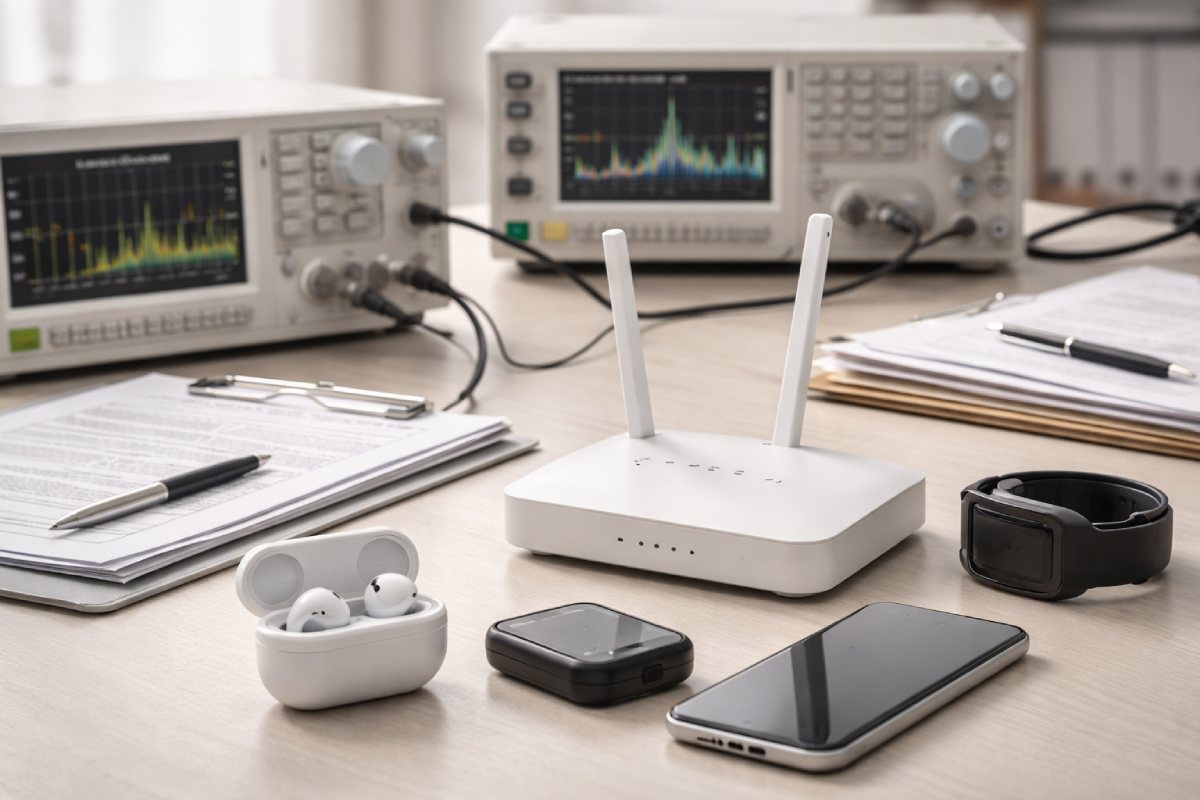
Selling within the European Economic Area (EEA) requires CE Marking for Wireless Devices because it serves as a legal requirement.
Any company that produces Wi-Fi routers, Bluetooth accessories, GPS trackers or IoT products must ensure their devices meet the Radio Equipment Directive (RED) 2014/53/EU requirements before selling them in European Union countries.
The RED Directive requires radio-enabled products to comply with essential health and safety requirements and electromagnetic compatibility (EMC) standards and necessary radio spectrum usage regulations.
The regulatory process requires an understanding of RED because it prevents delays, penalties and expensive product rejections in European markets.
What Is CE Marking?
The CE marking full form is Conformité Européenne. The CE marking serves as a conformity mark that demonstrates a product’s compliance with EU requirements for:
- Safety
- Health
- Environmental protection
- Consumer protection
The CE marking for wireless devices confirms that the product fulfills the RED Directive’s radio requirements, electromagnetic compatibility requirements and safety requirements.
The RED Directive Explained
The Radio Equipment Directive (RED) serves as the primary EU legislation that governs all wireless and radio-based products.
The law applies to all devices that have the ability to send or receive radio waves for either communication or positioning purposes.
The RED Act replaced the preceding R&TTE Directive as the current main directive that governs wireless CE marking.
Why the RED Directive Matters for Wireless Devices
The RED Directive contains important regulations that wireless devices must follow. Wireless devices create compliance risks that non-wireless products do not present.
The following examples demonstrate this principle:
- Devices create radio interference which disrupts the operation of other devices.
- The system generates RF emissions that present dangerous levels of radiation to users.
- The equipment demonstrates insufficient electromagnetic compatibility capabilities.
- The system creates unauthorized frequency spectrum access problems.
- The newer RED requirements create cybersecurity and privacy vulnerabilities for users.
The RED Directive establishes essential requirements that manufacturers must fulfill before they can sell wireless products in the EU market.
What Products Fall Under the RED Directive?
The CE marking directives list includes a radio module or wireless feature which makes it fall under RED regulations.
Common examples of CE Marking for Wireless Devices include:
- Wi-Fi routers and access points
- Bluetooth speakers, earbuds, and headphones
- Smartwatches and fitness bands
- Wireless keyboards and mice
- IoT sensors and wireless controllers
- GPS trackers
- Mobile phones and tablets
- RF remote controls
- Walkie-talkies and two-way radios
- Wireless alarm systems
- Zigbee/LoRa/NB-IoT devices
- RF-enabled medical or industrial devices (with additional rules)
Essential CE Marking Requirements for RED Directive (Core Compliance Rules)
Your product needs to fulfill three fundamental standards to achieve CE Marking for Wireless Devices.
1) Health and Safety (Article 3.1a)
The first requirement establishes health and safety standards through Article 3.1a which requires all products to meet these standards.
The product must provide:
- electrical safety
- mechanical safety
- thermal safety
- protection against hazards
The product needs to undergo safety testing because RED regulations apply to all products which include low-voltage items.
2) Electromagnetic Compatibility (EMC) (Article 3.1b)
Your device needs to meet two requirements according to Article 3.1b which establishes electromagnetic compatibility standards.
Your device needs to meet two requirements according to Article 3.1b:
- Not generate excessive electromagnetic disturbance
- Function properly in the presence of other electromagnetic signals
The product functions with reliable performance because it maintains proper operation between its active performance and the various environmental conditions which exist in real-world usage.
3) Efficient Use of the Radio Spectrum (Article 3.2)
The requirement requires the device to:
- Operate its frequency bands in the correct manner
- Avoid creating harmful interference
- Follow EU spectrum regulations
The requirement serves as one of the most critical RED requirements that apply specifically to this standard.
Additional CE Wireless Compliance Requirements for RED (Article 3.3)
The RED includes essential requirements that product types can choose to implement as optional requirements.
The device requires these three network protection elements:
- privacy protection
- fraud protection
- feature compatibility
- accessibility requirements
Important note
The EU has developed a stronger emphasis on protecting cybersecurity and privacy rights for wireless devices that connect to the internet. Manufacturers should not treat RED compliance as only RF + EMC + safety anymore.
Which Standards Are Used for RED Compliance?
The manufacturers test their products against EN standards to demonstrate compliance with RED requirements.
The primary categories that exist for CE marking radio equipment are as follows:
RF standards
- Frequency accuracy and stability
- Output power
- Occupied bandwidth
- Spurious emissions
- Receiver performance
EMC standards
- Radiated and conducted emissions
- Immunity testing
- Electrostatic discharge (ESD)
Safety standards
- Electrical safety for consumer devices
- Battery safety (if applicable)
- Temperature rise and abnormal operation
RF exposure standards
- SAR (Specific Absorption Rate) for body-worn devices
- RF exposure evaluation for others
The use of harmonised standards offers manufacturers an efficient method to show compliance because these standards establish automatic compliance standards.
What Are the Labeling Requirements Under RED?
Wireless products must usually include:
- CE mark
- Manufacturer name and address
- Product model number
- Batch/serial number
- Frequency band and power information (in many cases)
- Any warning symbols (if required)
CE marking rules still apply to products that will display their information on packaging or documentation when space restrictions prevent the complete display of their details.
FAQs
1. How to get CE certification?
To obtain CE marking you must first determine which EU directive applies to your product which in the case of wireless devices typically requires RED testing. Your product needs to meet all relevant EN standards first before you can start creating your technical file and EU Declaration of Conformity. You can proceed to apply the CE mark once you complete this process.
2. What products need CE marking?
All products that fall under EU CE directives must display CE marking according to European Union regulations. This requirement applies to wireless devices, medical devices, toys, electrical equipment, machinery, PPE, construction products and various electronics which are available throughout the EEA.
3. What are the CE RF requirements?
The RED Directive establishes RF requirements that demand efficient radio spectrum usage together with controlled output power, frequency stability and limitations on spurious emissions and protection against interference. Body-worn devices might need to meet RF exposure (SAR) testing requirements.
4. What are the CE marking for medical devices?
All medical devices require CE marking through the Medical Device Regulation (MDR 2017/745) and IVDR (2017/746) regulations. The process involves evaluating safety and performance through clinical evidence and technical documentation while implementing quality management systems and Notified Body participation.
Summing Up
The RED Directive serves as the primary requirement that sellers in the EU must meet to obtain CE Marking for Wireless Devices. The system provides basic safety protection together with electromagnetic compatibility control, proper spectrum management and additional security measures which depend on the specific product.
The RED directive requires manufacturers, importers and distributors to meet compliance requirements before they can enter the market. The CE marking process turns into an organized and easy-to-handle system through accurate testing, complete technical documentation and a valid EU Declaration of Conformity.
Businesses that invest in RED compliance from the beginning will prevent costly redesigns and their accompanying expenses which include failed lab tests, customs holds and enforcement actions.