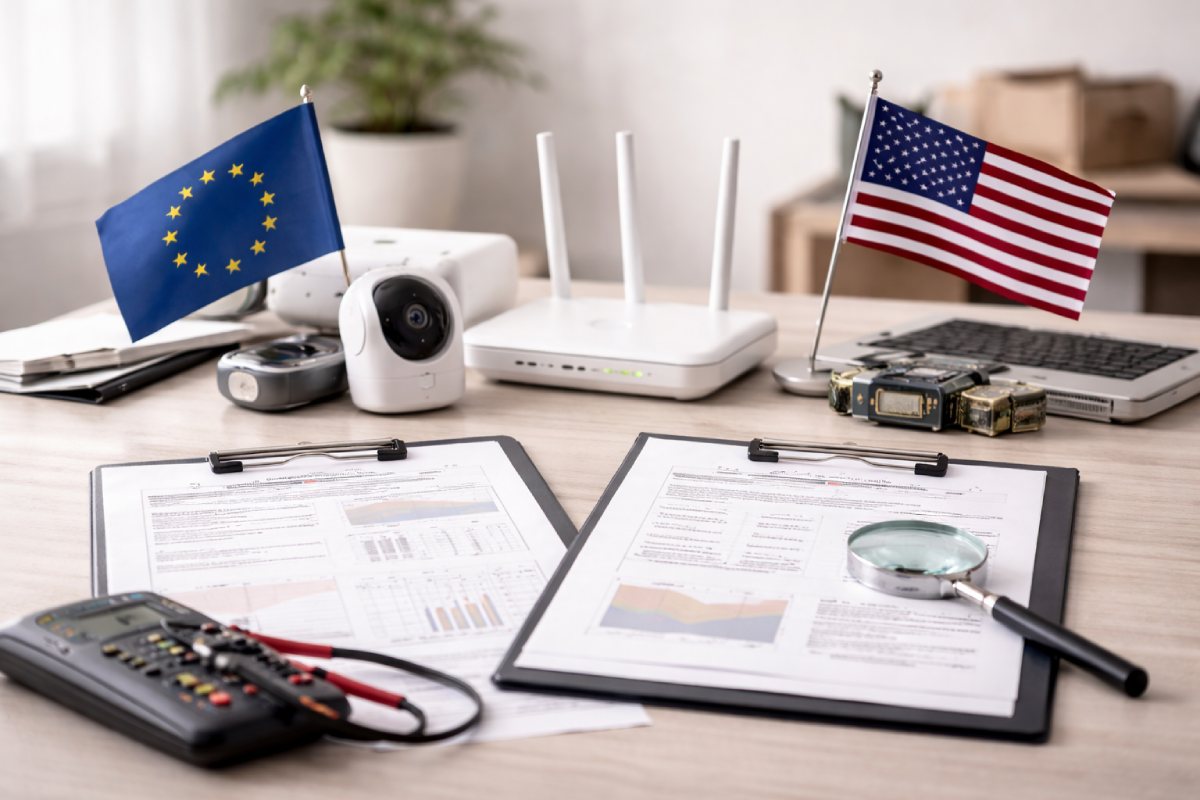
To understand global compliance, you first need clarity on CE Marking vs FCC, whether they mean the same thing, which markets they apply to, and which one your product actually needs.
The process of establishing worldwide access to markets starts with compliance for businesses that export electronic and wireless products. One buyer asks for CE marking. Another buyer demands FCC certification.
You need to determine whether these two requirements are identical which ones you must fulfill and which one is essential for selling products internationally. The truth is, CE and FCC are not interchangeable. The two systems operate in distinct territories which require different certification processes to comply with specific standards.
In this blog, we look at CE Marking vs FCC in detail so that your business can expand its exports throughout Europe and the United States.
Understanding CE Marking vs FCC
What Is CE Marking?
Showing CE Marking means a product meets required standards before it can be sold across Europe – including countries like Iceland, Liechtenstein, and Norway, beyond just those in the EU. Though not all goods require it, most must carry this symbol to legally move into that region’s marketplace.
Appearing on your item, the CE mark means it meets every basic condition set by relevant European Union rules instead of just some. Each rule tied to its category has been followed properly before this symbol gets added.
What CE Marking Really Means
The CE marking functions as more than a simple certification stamp.
The product serves as legal proof which shows that it meets essential EU requirements such as:
- Electrical safety
- Electromagnetic compatibility (EMC)
- Radio equipment compliance (for wireless products)
- Environmental compliance (RoHS, etc.)
- Product-specific rules (machinery, medical devices, toys, etc.)
Who Gives the CE Mark?
Here’s the part many exporters don’t expect:
The manufacturer or exporter needs to apply the CE mark because they have completed all necessary compliance requirements. Notified Bodies must evaluate certain high-risk product categories because these testing processes require their expertise.
However, manufacturers of electronics and wireless devices can declare their products as compliant through self-declaration, provided they maintain accurate testing and documentation standards.
What Is FCC Certification?
The Federal Communications Commission established FCC compliance requirements that organizations must follow in the United States.
Products need to meet FCC compliance requirements when they:
- Wireless devices create radio frequency energy through their intended functions
- Digital electronics generate radio frequency energy through their unintentional operations
- Devices operate using radio modules or transmitters
What FCC Really Covers
FCC regulations primarily address radio frequency interference issues together with radio transmission safety requirements.
The specifications of FCC compliance require testing to determine:
- EMI/EMC limits
- Radio transmitter requirements
- RF exposure in some cases
- Proper lab testing and filing (depending on device type)
Is FCC Always a “Certification”?
Not always.
The FCC compliance system provides multiple paths which include:
- FCC Supplier’s Declaration of Conformity (SDoC) for many digital devices
- FCC Certification (more formal approval) for radio transmitters
- But in export discussions, people loosely call both “FCC certification.”
CE Marking vs FCC – The Core Difference
The principal distinction between CE vs FCC certification is that the two systems arise from this point:
CE Marking operates exclusively in European markets.
FCC controls telecommunications services across the United States.
The two options do not compete with each other.
They are almost like two different passports that serve distinct international travel routes.
A product can have both CE and FCC certification, but as per Global certification requirements, it often needs both.
CE Marking vs FCC: Quick Comparison
The CE FCC difference has been compared below:
| Factor | CE Marking | FCC Compliance |
| Region | EU/EEA | USA |
| Authority | European regulations/directives | Federal Communications Commission |
| Focus | Safety + EMC + Radio + Environment | EMC + Radio transmission |
| Who applies it | Manufacturer/importer | Manufacturer/importer (with FCC ID for certified devices) |
| Mandatory for | Products sold in EU/EEA | Products sold in the USA |
| Common documents | DoC, technical file, test reports | Test reports, FCC ID filing, SDoC |
Which One Is Required for Global Exports?
Exporters experience their biggest delays.
The correct response is:
- The requirement for global exports does not mandate either of these elements.
- The first element needs its own market while the second element needs its own market.
- All regions require exporters to comply with their specific regulations.
- Exporting to Europe requires exporters to obtain CE Marking.
- Exporting to USA requires exporters to achieve FCC compliance.
- You need both certifications to export to both destinations.
Can CE Replace FCC (or Vice Versa)?
No.
This is one of the most expensive misunderstandings that exists in the process of exporting goods.
The USA does not recognize CE certification as an equivalent replacement for FCC certification.
The European Union does not accept FCC certification as an equivalent replacement for CE certification.
The two standards test electromagnetic compatibility but they differ in their testing procedures, acceptable limits and their complete regulatory framework.
Think of it like this:
A driving license from one country may prove you can drive, but it doesn’t automatically let you drive everywhere without local rules.
What If You Export to Both the EU and USA?
The standard procedure for Europe vs USA product compliance requires you to perform both CE compliance testing and technical documentation work.
- You need to conduct both FCC testing and certification through SDoC and labeling procedures.
- The manufacturing industry uses this approach because it helps them achieve their production goals while reducing expenses.
- The Smart Strategy requires you to develop two separate plans for your wireless product because it needs both CE and FCC testing for its wireless operations.
- The non-wireless digital product needs to follow two separate standards for certification.
- The product must meet CE requirements through the EMC Directive and LVD while it needs FCC certification through SDoC and EMC rules.
Common Mistakes Exporters Make
1) Thinking CE is a “Certificate”
The CE marking system requires documentation support as its foundation. Third-party certificates do not always serve as the system’s authentication method.
2) Assuming FCC is Optional
The FCC requirements become necessary when your product needs to comply with US sales regulations which include FCC requirements.
3) Using Incomplete Test Reports
A partial EMC test report is not the same as full compliance.
4) Ignoring Labeling Rules
Products that meet all requirements will face rejection when their labeling elements and manual content present incorrect information.
5) Not Planning Compliance Early
The product development cycle requires organizations to integrate compliance needs into their process.
FAQs
1. What is the difference between FCC and CE?
The FCC establishes US regulations that require testing of radio frequency interference and wireless technology compliance. The CE marking serves as an EU requirement that mandates products to meet safety standards, electromagnetic compatibility requirements and environmental protection regulations based on their specific product category.
2. Is FCC certification accepted in India?
The answer is no. India requires companies to follow its specific compliance standards which include WPC for wireless systems and BIS/CRS for various electronic devices. Indian approvals require more than FCC reports because they only provide technical information.
3. Is CE marking the same as certificate of conformity?
No, CE marking and certificate of conformity are very different. The CE mark is a mark that legally promises their item meets European rules. It is not a certificate itself. On the other hand, a certificate of conformity may exist additionally, especially if an approved agency steps in. Both tie into proving compliance, yet function differently under the framework.
4. What is the FCC CE certification?
There is no combined “FCC CE certification.” The FCC and CE testing systems operate as two distinct compliance systems that apply to different geographic regions. Some products have testing methods that can demonstrate compliance with both standards yet their documentation and legal obligations remain distinct.
Summing Up
CE Marking vs FCC compliance exist as separate requirements for different regions because both certifying standards enable businesses to enter various markets. European sellers must obtain CE marking as their required certification.
The United States requires most electronic and wireless products to meet FCC compliance standards. Manufacturers must obtain both certifications to sell their products worldwide because they need additional region-specific approvals.
The most effective method requires businesses to start their compliance process from the beginning while developing their product design according to industry regulations and creating necessary testing materials and documentation.
Compliance functions as a hindrance until organizations implement it correctly, which transforms it into an organized pathway that supports their international expansion.